Saturday, September 10, 2011

Obama's Suicide by Compromise

Of all the historical analogies that Conservatives call up, there's none they love so much as the story of Neville Chamberlain selling out Europe to Hitler. To hear conservatives tell it, it's always 1939, their enemy of the week is Hitler, and the Democrats are signing the Munich Accords. It's pretty obvious who plays Churchill. I hate the way they play this song over and over like Lynyrd Skynyrd wrapping up every set with "Free Bird." But I'm afraid that Obama might well go down in history as the person who irrationally tried to negotiate with extremist lunatics, except not overseas, but here at home. *

It's hard to overstate the degree to which Obama has squandered the enormous faith people had in him when he was elected.** The trouble started when he didn't ask for a big enough stimulus package, though many progressive economists warned him he'd need a bigger one. Then during the health-care fight he began by negotiating from the compromise "public option" position, then sacrificed that on the altar of conciliation to Republicans and "centrist" Dems like Nelson and Lieberman. And when it was all over Tom Dasche revealed that Obama had assured the health-care lobby he never intended to pass a public option in the first place.

But as bad as all that was, nothing is going to cost him like the way that he inexplicably pivoted to deficit reduction in the summer when Republicans decided to hold the entire American economy hostage during the debt-ceiling negotiations. Not only did he negotiate with these political terrorists, he supported their central assertion that the thing the government should be focusing on at that time was not unemployment near 10 percent (closer to 17 if you count realistically), but getting rid of the deficit right now.

Of course he made a bad judgement call. He decided to believe that the economy was going to get better, so now was the time to cut the deficit. But even if that's what he believed, against all evidence, he was wrong to negotiate with the Republicans like he did. I wouldn't have agreed, but I'd respect him, if he'd said: "I want to negotiate to cut the deficit, and I will. But I'm not going to negotiate until the Republicans stop threatening to bankrupt our country."

With his jobs speech, of course, he's taking something of a stand, at least rhetorically. But even now he points out that many of the proposals in the Jobs Jobs Jobs Jobs America Jobs Jobs Act, or whatever it's called, were originally proposed by Republicans. If he wasn't an adult, and the President of my country, I'd get a tear in my eye at the innocence of such a statement. Does he really believe that will keep them from opposing them? The public mandate was invented by Republicans, and now there are Republican State Attorneys across the country trying to get it invalidated as unconstitutional.

It's too late now for him to do much anyway, but even if it wasn't there is absolutely no reason he won't walk into negotiations over this bill by preemptively throwing out anything the Republicans won't like only to have them scream that every conservative idea he has left for them is Kenyan Socialist extremism.

But you don't understand! scream his defenders. He's just a president, he can't pass laws. He can't make the legislature do anything they don't want to do. They will give a million reasons why he never could have gotten any of that stuff anyway (even when he had a massive majority in the House and a supermajority in the Senate). They'll say at least if he looks reasonable people will realize how extreme the Republicans are. Never mind that it's not working. Never mind that even the American people want him to stand up more. Was this the message they were planning on running on? "No, we're not fighting for anything you believe in, but it doesn't matter, because we couldn't get it anyway." In 2008 it was, "Yes we can!" In 2012 it's apparently, "Sorry, we can't, but it's not our fault!"

In other words, just like Neville Chamberlain kept trying to negotiate with Hitler far past the point when it was clear that he was a maniac who would accept no outcome short of taking over the world, Obama refuses to see that the Republicans today are a death cult who care nothing about the good of the country and only want to cement their own power and further enrich their friends.

Maybe Obama will still pull it out. Maybe by some miracle the economy will turn around in the next six months or so (after that it will be too late). Probably his best hope is that the Republicans will nominate someone insane enough that he alienates mainstream America, though if the economy's really bad and Obama sufficiently turns off the people that believed in him, even that might not be enough.

Then, when historians chronicle the decline of this country, Obama will be remembered as America's Neville Chamberlain after all.

* I guess here is where I'm supposed to point out that I'm not breaking Godwin's Law and actually saying the modern conservative movement is like the Nazis. So here goes: the modern conservative movement is not like the Nazis. But I'm going to bend the law a bit by saying that in many ways the difference is in the degree of the things they're doing, not the kind of things. Many contemporary conservatives are playing a milder version of the same reactionary nationalistic militaristic game, all the way down to irrational conspiracy theories about dangers posed by a religious minority.

** Many progressives will point out that I'm being very naive here, and that Obama was never the progressive many people thought he was. And they're absolutely right. And I'm doubly to blame because I supported him very early on (I donated to his campaign back when it was far from certain he'd beat Hillary) knowing perfectly well he wasn't really all that progressive. I did that partially because I was trying to be a "realist" and partially because I had a picture of him being sort of a Clinton-style moderate; I'm old enough to remember that things under Clinton weren't all that bad. Not that it made any difference who I supported anyway, but I'll say it now: I was wrong. It's not a mistake I'll make again.

Friday, April 1, 2011

Random observations about Guatemala to wrap up the trip

Just reserved a minibus ride back to the airport tomorrow. But I have lots of pictures and observations I haven´t shared yet, so I should be putting up some more Guatemala stuff for the next week or so. Maybe I´ll do a Flickr or Picasa slideshow or something.

I have mostly been writing today. I can write anywhere, of course, but today´s the last day I can write on the shores of Lake Atitlan!

To wrap things up, here´s some random observations about Guatemala:

Guatemalans love fried chicken, and you can get some of the best fried chicken I´ve ever had here. There´s a Guatemalan chain called Pollo Campero which has become the KFC of Central America, but way better.

In a country that grows some of the best coffee in the world, everyone drinks instant! It is pretty much impossible to get a decent cup of coffee in this country except in tourist towns like Panajachel or Antigua. If you can persuade a Guatemalan to brew a cup of coffee in most places it will be so weak you can see through it to the bottom of the cup. In Pana you can get espresso, and you can also buy Guatemalan beans to take home. But it´s kind of ridiculous to do so. There are five or more places within 15 minutes walk of my house where I can get several varieties of Guatemalan coffee, either by the cup or in beans, more easily than I can get it here. Of course this is partially about economic inequality, but not entirely. I spoke to a woman whose father works on an international award-winning coffee plantation who could get the beans free but still prefers to drink instant coffee.

Guatemalan picante sauce is made with pickled cauliflowers, cabbage, peppers, onions and other vegetables in a sort of greenish sauce.

In a nod to Guatemala´s German influence, Mayan food will often have a side of something kind of like cole slaw. But this slaw usually will be made with potatoes and carrots instead of cabbages, which is weird because the Mayans eat lots of cabbage otherwise.

Corn tortillas here are about half the diameter of the kind you get in the US, but about twenty times as good, especially straight off the grill. In Mayan meals especially, you always get way more tortillas than you can possibly eat. But it´s hard to get tortillas packaged to take home, I guess because people assume that everyone knows how to make them.

In Mayan villages, people just tie their pigs up anywhere. The piglets just run through the town, along with the chickens and turkeys and of course the dogs.

Speaking of dogs, in Mayan villages they almost never go inside and rarely get pet except maybe by kids when they´re puppies. Even the most neglected dog in the US would be ridiculously spoiled by the standards of Mayan dogs, who mostly hang around outside with visible ribs waiting for any scrap anyone throws them. To give you an idea how how hungry a Mayan dog is, when I was cleaning dishes outside before I left Santiago de Atitlan I scraped off a large chunk of plain dried rice left over in a pot, and a dog that had been hanging around the house ate every bite of it. Find me a dog in the US that will eat dried rice!

Houses, especially in Mayan villages, are painted in brilliant pastel oranges, blues and yellow over stucco or adobe. Doors are painted with geometric multicolored arcs, stars and crescents reminiscent of Moorish Spain.

The country of Guatemala has a schizophrenic relationship to Mayan culture. On the one hand Mayan history is the center of the country´s identity. There are pictures of pyramids and Mayan glyphs everywhere. The Mayan sacred bird the quetzal is both the national animal and also the namesake of the currency. And a one-quetzal bill has a watermark of the Quiche prince who died resisting Pedro de Alvarado. On the other hand, Mayans themselves remain the lowest social class. In fact nearly everyone here is part Indian. But Ladinos, who are more Spanish than Mayan, run nearly everything and have most of the money.

In Panajachel you will see Mayan men wearing traditional Mayan clothes of brightly colored striped pants and shirts. But in most places Mayan men wear the kind of clothes that from the waist up wouldn´t seem out of place at the State Fair in New Mexico: western shirts and cowboy hats. For pants they tend to wear slacks instead of jeans and on their feet they wear a sort of tough outdoor wingtip shoes instead of cowboy boots. Boys, when they can get away with it, prefer jeans and hoodies pretty much like American kids.

On the other hand Mayan women and girls nearly always wear traditional Mayan skirts and blouses. The popular headgear in the Highlands is a striped scarf tied around the head with a double knot covered with another scarf, usually in a paisley or flower pattern, wrapped over the knots. The whole arrangement looks like a sort of bulbous hat that projects over their foreheads, and also conveniently keeps the sun off.

Mayan women can effortlessly balance enormous bundles wrapped in Mayan blankets on their heads, and walk for miles with them. If they have to carry something especially heavy, like a load of firewood, both men and women use a sort of rope net-pack that hangs down their back from a strap that goes over their foreheads.

The longest, most arduous hike you´ve ever been on would probably be a routine stroll to most Highlands Mayans. It happened all the time that while riding in a bus through a mountain forest with no habitations of any sort in sight a Mayan man, woman or family would whistle to the bus driver then jump out in the middle of nowhere so they could walk several miles up some nearly vertical little dirt path to a house or two at the top of the mountain. And this would be their daily commute.

I´m sure I´ll think of some more. Thanks to everyone who has been reading. Now that I´ve got my blog going again I´m going to try to keep it active, though I´m not entirely sure what I´ll be writing about. In any case, I´ll try to keep it interesting.

Thursday, March 31, 2011

Bad dentistry and daykeepers

By most people´s standards today was a ¨wasted¨ day. Not that I didn´t do anything, but I didn´t do anything I could have only done while I´m in Guatemala. In the morning I was writing -- rewriting actually, the scene where the Hero Twins kill the demon Seven Macaw with bad dentistry. This is one my favorite scenes in the Popul Vuh, and one of the scenes that inspired me to write this trilogy. So naturally I want it to be really good in my book as well.

As an utter bonus, I have discovered that fancy artificial teeth are quite popular in Guatemala, especially among the Highlands Mayans. I assume this is partially because of the dreadful state of dentistry (along with any other modern medical care) for the people in small towns in the Highlands. I have seen a number of pairs of gold front teeth with golden crosses or other symbols in the middle of the white enamel. It is not much of a stretch to imagine someone replacing the enamel of the teeth with brite green jade, as Seven Macaw did in the PV. Since this is in the PV this was presumably a normal part of dental care even in pre-Columbian times. I wonder to what degree they still use the same methods?

I might have gone out, but I stopped into ¨Bus Stop Books,¨ and English-language bookshop and coffee shop here. I was just going to buy a couple of scifi paperbacks as I always do when I find an independent bookshop I want to support. But then in the ¨library¨ section I saw a book called ¨Breath on the Mirror¨ by Dennis Tedlock. Tedlock wrote the most authoritative translation of the Popul Vuh, and he is the only non-Mayan I know of who has learned enough of the language and culture of a Mayan tribe (the Quiche, in this case) to earn the title of daykeeper.

The Mayan ceremonial system is centered around the counting of days. This is not on the 360+5 day calender that´s part of the ¨long count¨ system that has everyone freaking out unreasonably about 2012. (If anyone asks you, tell them that not even the Maya believe that year represents the end of the world.)

But the daykeepers focus on the ceremonial 260 day calendar. There´s disagreements about where the 260 days come from: it could be connected to the growing cycle of corn, or the orbit of Venus, or the gestation period of a human pregnancy, or some combination of all of them. But mathematically it´s pretty clear: 260 is the product of two important numbers, the 13 ¨day numbers¨ and the 20 ¨day names.¨ The day names are things like Deer and Marksman and Cane, and they confusingly move backwards while the day numbers move forwards, giving each day a name like Seven Wind or One Yellow. Each day has a meaning which can also change depending on how far along in the numbers it is. For example Yellow means ¨ripeness¨ but while One Yellow represents something just coming into its ripeness, 13 Yellow, being at the end of the number cycle, means something that´s going rotten. Daykeepers can count the day numbers and names together and know what each combination means. This means they can say something about you based on the day you were born, sort of like a horoscope (I was born on the day ¨E¨ or ¨Ey,¨ which can mean ¨tooth¨ but also means ¨path¨). But more importantly they make predictions by a system of tossing and counting ceremonial beans.

And the predictions of the daykeepers, called aj´chun (at least in the language of the Chuj that live in San Mateo), are still central to the lives of the Maya. Angela´s Mayan husband Alberto uses their services routinely. Among other things, he told us, he told us he talked to an aj´chun to see if she was being truthful to him. She was sitting right there when he said that, so maybe he was being playful.

One important role of an aj´chun is when you get sick. Not that an aj´chun can cure you, since their only job is to see fortunes. But if you get a swelling in your leg or a mysterious sickness in your stomach, the most likely explanation is that you have been curse by a bruja, or witch. Specifically this kind of witch is known as an aj´lep, someone who puts sicknesses on the body. Since the only one who can really cure the curse is the person who cast it, the aj´chun can tell you who the aj´lep who cursed you is. From there, presumably, it´s up to you.

Then there are the men that kill the snakes. If you get a snakebite, it will continue to hurt if you are still alive. The ¨snake-killer¨ (Alberto didn´t give a Chuj name for this profession) will give you a treatment that involves drinking tobacco juice and massaging and blowing on the place where the the snakebite happened. If the treatment works, it will kill the snake and cure the bite.

The nearest hospital to San Mateo is a bumpy 5-hour dirt road bus ride away. There is a small pharmacy that sells some prescription medicines, and some medicines are sold randomly out of boxes on market days. But even if there is a doctor there that can prescribe what you need, most Chuj couldn´t afford an appointment. And if they could, the pharmacy might not have the right prescription anyway. So for many people finding the witch that cursed you is as effective a treatment as modern medicine.

Alberto´s an intelligent and sophisticated guy, who also knows a lot about his people´s traditions. He also enjoys talking about them, and is a natural storyteller. A person like me is tempted to want to press such a person, to find out exactly how much of what they´re saying they really believe.

But I don´t think questions like that can ever have a simple answer. Mayans have been forced for a very long time to live in two (or more) worlds, balancing their old faith with Christianity and traditional practices with modernity. And really, don´t the rest of us do the same thing? Nearly everyone I know mixes some ¨alternative medicine¨ practice with modern medicine.

Mostly I am just thankful to Alberto for opening up and sharing as much as he did, which helped me connect the beliefs in the books I was reading with what I was seeing around me. It´s amazing how many connections I have found.

That´s why I had to read the Tedlock book right then. Tedlock has an incredibly useful section describing the exact day name and number connected to the various events in the Hero Twins´ battle with the Lords of Xibalba, or Death, and what each of those days mean. That´s perfect for me, as I will be writing that book in about 6 months, which is exactly as long as a piece of research needs to sink in before you can really use it in your fiction.

Wednesday, March 30, 2011

¨Do you want to see where we lived when the soldiers came?¨ -- Parque de la Paz

Alex was a fantastic guide, but he only spoke Spanish. I did my best to listen to what he said, but my weak Spanish interfered. Mostly this didn´t matter much, because most of what he showed me was routine tourist things I understood well enough.

Then he took me to Parque de la Paz. The story of the park is clear enough. During the Civil War Santiago de Atitlan suffered as all the Mayan villages did from the near-genocidal efforts of the Guatemalan military. A Catholic priest, Father Stanley Rother, was killed in 1981, and all through the 80s people from here ¨disappeared.¨ In 1990 an angry crowd gathered and threw stones at a Guatemalan military base, and the military massacred 13 people. But because Santiago de Atitlan is a tourist facility the military was forced to withdraw to avoid further embarassment.

In memory of those massacred the village has erected ¨El Parque de La Paz,¨ a beautiful stone park with small marble memorial stones to those killed in the massacre. The story that I didn´t understand from Alex I could read in the marble plaque on the side.

I didn´t understand exactly what Alex said next, but he asked me if I wanted to see the houses.

¨What houses?¨ I asked.

¨The houses where we lived when the soldiers came,¨ he said.

So I followed him. We passed a residential part of the village. Some women were weaving on traditional looms. Then we passed a school, but it was empty even though it was a school day.

Then we passed a hospital, also abandoned. Alex pointed to a field across from the hospital. Many people lived there, he said, though I didn´t understand the rest of the sentence.

Then we walked a little further. We came upon the wrecks of a number of stone houses. They looked burned out, and there was ash in the dirt. Alex walked to one of the houses. I understood what he said next.

¨I lived here. The river used to pass this way. I was five years old. They killed my father and my mother right over there.¨

A couple of times I have had people ask me what the Popul Vuh ¨means.¨ I have found this a difficult question to answer, and not just because I am still an outsider studying it. What does the Bible mean? What does the Odyssey or the Gilgamesh mean? It is the story of the people, and it would be ridiculous to try and sum it up.

But I´ve still put some thought into one strong message that comes from the book. The PV is ridiculously violent. Through the course of the book the heroes lose limbs, have heads cut off, are killed and chopped up and burned and thrown in the river. And yet they always come back. In a sense there is something almost cartoonish about it, and Hunahpu and Xbalanque aren´t supposed to be normal people. ¨They were just gods,¨ says the book.

But I can´t help but think there is a theme that is connected to this: no matter how you try to destroy the Hero Twins, they always bounce back. They always survive. And in the face of terrible violence and evil they always find a way to win through a combination of trickery and courage.

As I said, these are the stories of a people. Though the PV was specifically Quiche, I am pretty sure that the part of it that is the story of the Hero Twins is pretty universal to the Maya. And if one was forced to sum up a ¨message¨ from the book, it would be this: you can conquer us, you can massacre us, you can try to take our land and destroy our culture, but we will survive. We will come back.

The Mayans suffered under oppression from the Aztecs even before the Spanish came, then they suffered the horrors of colonial oppression. Their literature was burned by the Spanish monks in a crime against human knowledge equal to the destruction of the Library of Alexandria. For the next few centuries they rose up repeatedly against Spanish and Ladino oppression, and were suppressed violently. Their land was taken to make coffee and sugar plantations, and they were forced to work under conditions little better than slavery. And in the civil war, villages like San Mateo de Ixtalan suffered much worse than better known villages like Santiago de Atitlan. Fernando said that during the 80s more than 3000 people were shot on the picturesque bridge that overlooks the valley below the house where we were staying.

But, in the words of Faulkner, the Mayan people endured. Just like the Hero Twins, they survived through a combination of courage and necessary deception. When the Spanish tried to destroy their beliefs and culture they hid them away while pretending they were doing what they were told. But when the Spanish and later Guatemalan military pushed them too far they would get together and stand for their rights, knowing that many of them would pay the price of their lives.

And now they are still here, with a culture that is as strong as it ever was. The culture they have now isn´t the culture they had 500 years ago; like everyone else they have developed new skills and ideas while adapting ideas from the outside as they were useful. But the culture they have now is distinctly their own.

Maximon, el Rey de Muerte and el Rey de Sol

I took the boat today across Lake Atitlan to the village of Santiago de Atitlan in search of the figure of Maximon, the cigar-chomping hard drinking wooden doll that is the subject of Nathaniel Tarn´s book A Scandal in the House of Birds. Maximon is a purely syncretist figure. He represents Judas, but he is also associated with the traditional Mayan Lords of Death. The Church made many efforts to eradicate him from Mayan worship, but obviously without success. In Tarn´s book the Mayans were rarely openly defiant about keeping Maximon. Rather, they would tell the Church not to worry, they were rid of him. Then Maximon would be leading the next parade.

The ride across Lago de Atitlan is stunning. There are enormous volcanoes stretching into the clouds all around, and little villages stuck to the side of the green hills that surround the lake. The vegetation is still mostly evergreen but mixed with some tropical plants like banana trees.

I thought Maximon would be hard to find, but he was not at all. I was trying to decide who to ask while I was busy shooing away the tuk-tuk drivers surrounding me trying to give me a ride. Then it occurred to me that one of the drivers might know. I was afraid I'd be taken for an expensive wild goose chase, but the driver I asked just gestured up the road. I wasn´t sure where he was pointing, but I started walking that way, and a man came and asked if I was looking for Maximon. His name was Alex, he was a cakchiquel man who looked about my age but was actually younger, as I found out later.

He walked me down a small street, then led me up a small alley. I already knew that Maximon moves around from house to house, so I followed him.


Maximon was up this alley.

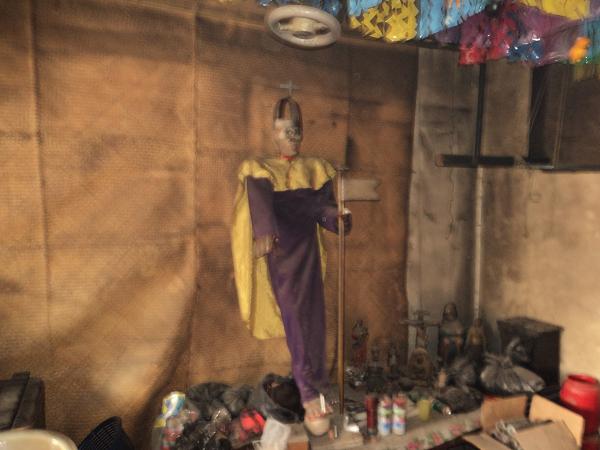
Admittance was two quetzales. Maximon was in a dark room hung with colorful paper and illuminated only by candles. He is mostly a decorated mask with a cigar clothed in nothing but a bunch of silk ties. I wasn´t sure if I could get a picture, but Maximon is an entrepreneurial fellow, and you can take pictures of him for ten quetzales more. His hands hold trays where you put the money. In fact you´re supposed to also leave him cigarettes and liquor, but I wasn´t prepared that way.


Maximon

Off to the right of Maximon is a casket that represents Jesus. To the left is a statue of Jesus carrying the cross. That is the only two figures that they went out of their way to show me. But there is another figure on the left.


Casket of Jesus

The statue on the left was recessed into the darkness. He had a metal mask and was dressed in a robe. There was a cigarette sticking between his toes. I asked who he was, and Alex said in a somewhat embarassed tone, ¨Ah, ese es El Rey de Muerte,¨ or the King of Death.

¨De Xibalba?¨ I asked, but no one answered.


El Rey de Muerte

Then Alex offered to give me a tour of the Church and the rest of the town for Q100. I agreed, because I was grateful to him for showing me Maximon and because he seemed to know his way around. I´m sure I could have haggled him down to Q50, but I am glad I didn´t, because of what I saw later.

The church, much like the one in San Mateo, is about 500 years old, and has a peaked roof instead of an arch in the Mayan style, but is much bigger. The walls are lined with statues of different saints. Alex insisted it was okay to take pictures in the church as well.


Some of the Milagros on the walls of the church

In the back of the church were several large triangular altars illustrated with statues of Jesus, Mary and more saints. In the lower-right hand corner was a seated figure with a brightly decorated face. Alex informed me that that was El Rey de Sol, the King of the Sun. On the side of the altar a man was climbing. Alex told me that he was going up to talk to the man at the top, El Rey de Ciel, or King of the Sky. I suppose if I´d pressed Alex he´d have told me El Rey de Ciel was the same as God, and maybe El Rey de Sol is as well. But the real answer probably isn´t so simple. Anyway, I didn´t press.

I wasn´t sure what else Alex would show me, but I was willing at this point to see whatever he had to show me. So he offered to take me to ¨El Parque de Paz,¨ or Peace Park.

What I saw at Parque de Paz was much deeper than anything I saw at El Maximon´s or the church. Enough that it needs another post.

Tuesday, March 29, 2011

As a matter of fact this is a tour guide, asshole.

I'm in tourist haven Panajachel, which is nice. But there are some real assholes here. I'm not talking about the Guatemalans, who are friendly everywhere I go. I'm talking about the foreigners, or as they prefer not to be called, the tourists.

I moved on for several reasons. Part was that I didn't want to wear out my welcome in San Mateo. Part was that I want to check out Lake Atitlan, and see if I can find the Maximon, a tobacco smoking, hard-drinking wooden icon who's half Judas and half dark Mayan diety. But honestly a big part is also I was ready for things to get a little easier.

And they did, eventually. Getting to Pana was the usual madhouse of jumping from brightly colored bus to minivan & back for hours on end & praying you don't go the wrong way or miss your stop. But as soon as I was here I had a motel room with laundry, private bath & shower and wifi for Q100/night. It's not even close to the top of the line, but after a week in San Mateo it feels like the Ritz.

After I came out of the shower I went by the kitchen and said "hi" to an American-looking couple in the kitchen. They responded with a cold "hola", and at first I was embarassed for assuming they were English-speakers. But then I heard them speaking English to each other with an American accent.

Then I went looking for a place to eat. I had out my guide book, glad to finally have a use for it.

I saw a man on a bicycle who looked friendly at first and waved to him, this time greeting him in Spanish instead.

"You got your little tour guide?" he said in English. "Which one is it?"

Sensing he was being contemptuous but not sure I told him it was a Lonely Planet.

"Oh, is it lonely?" he said with an eye roll, and pedaled off.

This is one of those situations where you think of what to say too late. Fortunately that's what blogs were invented for. So here's the correct answer to the question:

Yes, you self-righteous prick, I need my little tour guide to get around Pana because instead of spending my time in Guatemala hanging around here I've spent the last week nine hours into the Highlands over unpaved roads in a place that isn't even in most guidebooks, which you probably wouldn't go to if they paid you. And now I'm ready to just chill the fuck out and be a goddamned tourist for a couple days if you don't mind, like every other foreigner in Pana whether they have a little tour guide or not. And that includes you, even if you've been here since you fell off the Magic Bus on an acid trip in the 70s.

Monday, March 28, 2011

More pictures

Pictures below accompany previous posts

Tara with kids on the field trip


Measured this slope as a grade of 20 degrees


I don´t think this would be a NYCDOE-approved form of field trip transportation for 20+ kids.


Tierra negra


Diego has spent some time in the US


Angie really knows the town well


Looking up the stream


Fernando climbing the stream


Me climbing the stream


The milpa from the waterfall


The milpa from the top


We slid down this cornfield to the path home