Showing posts with label Mayan beliefs. Show all posts
Showing posts with label Mayan beliefs. Show all posts
Tuesday, July 10, 2012
Google Plus Photo Album
To make up for the fact that I never really finished the account of my second Guatemala trip, I've created a Google+ photo album of about 700+ Guatemala pics. Right now it's completely unsorted and unlabeled, but I'll work on that. You can see it at:
https://plus.google.com/photos/114457936792556570427/albums/5763298730859843169

Monday, March 26, 2012
Rotten Cane


Auilitz was one of the three gods the stories say the Quiche brought back from the magic city of Tulan Zuyua in the east. The gods took the form of stone icons that could speak in the time of "shadows," when the First People had just been created and the sun, moon and stars had not yet shown themselves. The actual icon of Auilitz was hidden in one of the plunging canyons near here.
It's tempting to think of the Mayans as innocents who were living their lives peacefully until they were set upon by European colonists. But at least in the case of the Quiche, that would be a mistake. The Quiche were expansionary and agressive, fierce conquerors who overthrew and colonized numerous other settlements ranging from Lake Atitlan all the way up to the border of the Peten. The captives in these wars were dragged back to Rotten Cane, where they were sacrificed in front of the temples of the Quiches' three main gods: Tohil, Auiliz and Hacauitz.
I have heard that in some Mesoamerican cultures, the victims of human sacrifice were honored guests, treated well right up until their death. That may be, but as the Popul Vuh makes clear, that was not the case for victims of Quiche sacrifice. The PV states that the Quiches earned the right to sacrifice the members of bordering tribes through a horrifying story of trickery, and that they took full advantag of that right.
The time of shadows was, as one would imagine, extremely cold. All the tribes were freezing to death, but only the god of the Quiches, Tohil, was able to generate fire. Naturally all the other tribes begged to get a bit of the Quiches' fire. The Quiches said they would give them fire on the condition that later on they could "suckle at the breasts" of the other tribes. The other tribes agreed, not knowing that what that meant was in fact cutting out their hearts.,/p>
After the sun rose, the icons themselves no longer spoke directly, but instead spoke through spirits of young boys that demanded that the First Men hunt down the men of the other tribes, possibly in were-animal form, and then feed their hearts to the bloodthirsty child spirits of the three gods. When they were done they'd leave the skulls in the road as a message to everyone else. It's nearly impossible to put a positive spin on the First Men here; to a modern reader they essentially appear to be forest-dwelling serial killers. The point of this is not to put down the Quiche or excuse the depradations performed by the colonists upon them, but to point out that the Quiche were, up until their fall, what we would call Bad Mother F**kers.
Now, however, their capital is a haunting forest full of dirt mounds, bird chirping in the trees.


But this would be the ballcourt with which the scribes that wrote down the alphabetic PV were most familiar, the ballcourt where they likely saw games played in their lifetime. The game must have been incredibly difficult; somehow you had to knock a rubber ball through a vertical stone hoop nearly the height of a basketball hoop just using your hips. Contrary to popular belief, the losers (or, as some say, winners) probably did not usually get sacrificed. The game was played only by high-born nobles, and the Spanish colonists wrote that the nobles played for money, cacao and slaves. It seems likely to me that the losers had to give up some of their own slaves to be sacrificed by the winners, maybe as symbolic substitutes for the lives of their defeated masters.
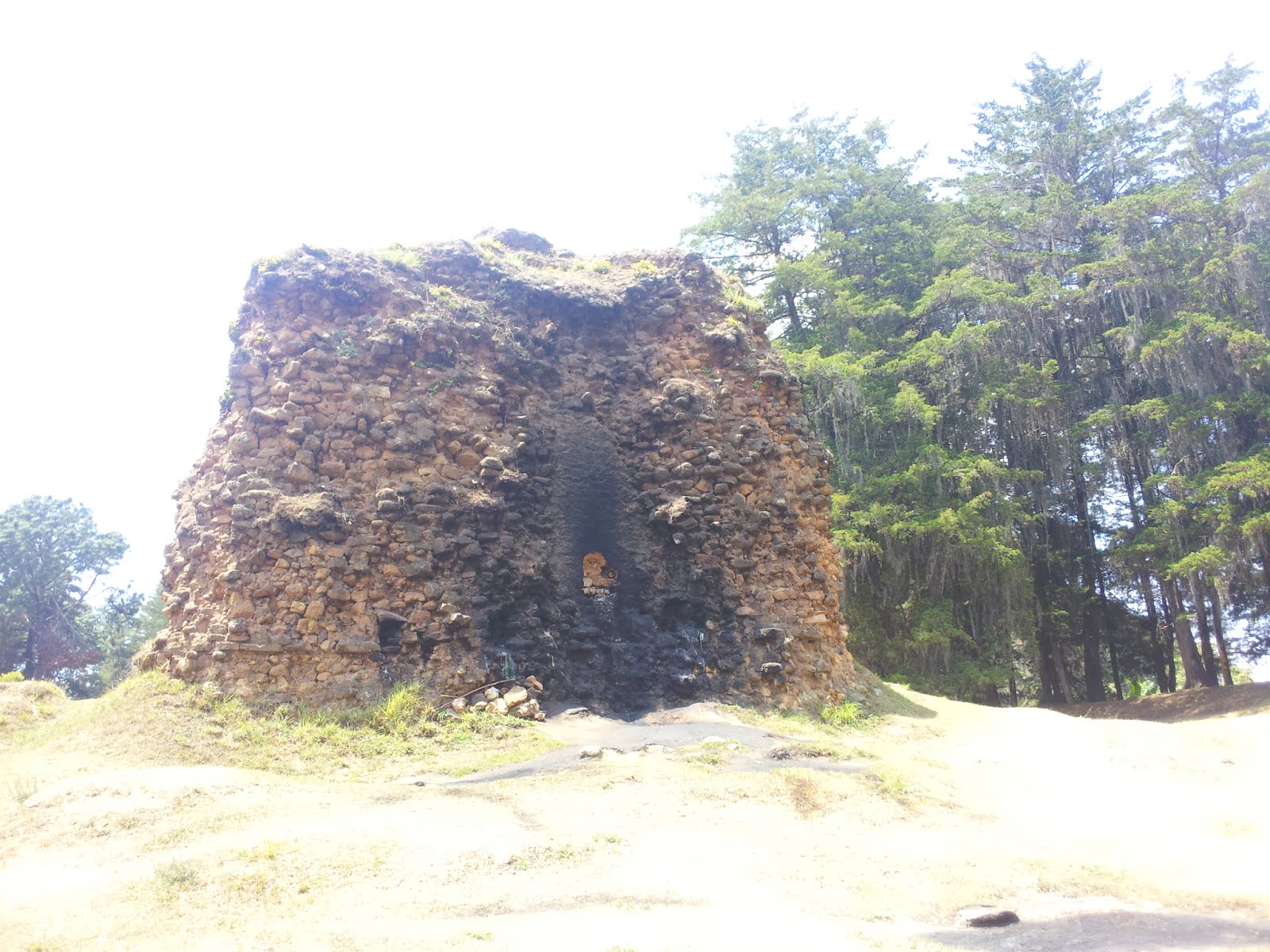
Though the Temple of Tohil is large and impressive next to the other delapidated mounds of Rotten Cane, it would be a pipsqueak compared to the much larger ruins of the Peten and the Yucatan. Neither its size or its condition is what is interesting about it.

The temple of Tohil, Hacauitz and Auilitz are in every way temples in active use. They are active today, and most likely have been active without interruption since the Spanish tried to destroy them and everything they stood for.
Rotten Cane is called a citadel, but it is a mistake to think of it as a city. Like a city, Rotten Cane had palaces, offices, towers and temples. But a city is also a palce where ordinary people work and live, marry and have children, run businesses and make homes.
The people who live in Rotten Cane would have been kings, officials, lords, commanders and priests. These men were most seized by the Spanish when the city fell, to be tortured and hanged or burned, something that was also recorded in the alphabetic PV, which was written after Rotten Cane's fall. But the regular Mayans would have lived in smaller villages on the surrounding hillsides, working milpas, raising families, building houses, keeping animals and hunting.
Five centuries later, the descendants of those people still live there.

But the working people would certainly have climbed to the citadel to make their own offerings to these temples for blessings on their marriages and childbirths, harvests and hunts.
In the 21st century, they still do.
The towering ruins of Chichen Itza and Tikal, impressive though they are, are ancient remnants of stories long forgotten even by the people who still lived in the area. I am told that there are efforts in some places to revive these rituals, but as hard as anyone tries it can only ever be a reenactment.
But the story of Rotten Cane is still being told. Just as they have for the last five centuries, the Christan priests struggle unsuccessfully to get their parishioners to abandon their old faith completely and confine their worship to one jealous diety. And the Mesoamerican Indians still fear the oppression of Ladino overlords, whom some Mayans still call the 'Spaniards.'

The citadel is a ruin, its stone structures are destroyed. But it's not dead. In spite of all attempts to kill it, it is alive as it ever was.
Friday, March 23, 2012
Pascual Abaj - The Sacrifice Stone
I suppose I hoped for more from the Museo de Arceologico in Chichicastenango, though that's not really fair. They have two long rows of glass cabinets filled with old pottery ranging from the pre-classic (before 300 BC) to the post-classic (1100-1500 AD) period, along with a small collection of jade artifacts. (Unfortunately photographs are forbidden). But given that this is the central collection of archeology from the Quiche region in the heart of the Quiche department, one could only wish they had more.
Nevertheless, I'm extremely glad I went, because I met Hector, my guide to the Pascual Abaj shrine. I spent a long time looking at the pieces, and Hector asked me if I wanted a guide to the shrine. Based on my experiences in Santiago de Atitlan, I've learned that when a person who seems to know something offers to show you around it's worth paying what he asks.
The road up to the Pascual Abaj wouldn't stand out if you weren't looking for it. You pass through an older part of town, down a road lined on one side with houses made of adobe instead of rebar and cinder block like most of the newer buildings, and on the other with a fence overlooking a slope filled with milpas, or cornfields. I probably could have found my way myself, but paying Hector to guide me turned out to be well worth it. We passed up a small rise with a little sign labeling the direction of the shrine, and then through a building of orange stucco. This building was labeled the "museum of masks," something I was curious about. It appeared to be closed, so I kept going. We came to a path through another small milpa.


One thing distinctly lacking in this room was the cross. This is significant because often in Mayan syncretist altars there are at least a few, in order to show that the ritual isn't completely pagan. Although some of the glass candle holders had the Virgin Mary on them, this was the first place of worship I'd seen with no crosses at all (though not the last).


Duende is a term imported from Spain, where it means something like an elf or faerie. There are many Mayan tales of hills having a duende inside them that rules over the area, and provides good or bad luck depending on how well you treat them. I assume that just like in Europe, when pagan gods get demoted by the rise of monotheism, people start calling them duende or spirits instead.
At the top of the hill is Pascual Abaj, or sacrifice stone, itself. Pascual Abaj is in a U-shaped enclosure of black stones covered with offerings, with a small firepit inside. There is a cross here, a stone one. The Pascual Abaj stone is shaped like a roughly carved head, but most of the lower section is covered with ashes, as if it's been burned away. About twenty feet in front of the half-circle of stones is another, larger firepit.


The rituals are simple, but this is syncretism in action. Offerings of flower petals, tobacco and incense were the same thing that the Quiche lords gave their gods, according to the Popul Vuh.

On the way back, I asked Hector if the Museum of Masks was closed. Hector called to a man in an adjoining workshop. The man got out a key and opened the door to the museum.


I asked if I could take a picture, and the proprietor said I could in that room, but not in the next. I asked what was in the other room. He said that these masks were old, but in the other room were new masks that he had made.
The masks in the other room were spectacular. Unlike the older masks, which were mostly stained wood with only a little decoration, these masks were finely painted in bright colors. Many of them were human faces with animals above them, animals that played an important part in Quiche mythology: owls, falcons, jaguars, snakes and toads. There was a mask with two catfish, which I recognized as symbolizing the reincarnated form of Hunahpu and Xbalanque after they are burned in the fire of the Lords of Death. There was another double mask labeled with the names of the Hero Twins, which warmed my heart.
Masks seem to play a bigger role to the Quiche today than I had anticipated. Nearly every room I entered in Quiche seemed to be hung with masks, and countless booths in the Quiche Market were selling masks as well. But none of them were near the quality I saw in the Museum of Masks.
I spent another day in Chichi, just to see the market, but I didn't buy anything. It's nice stuff, but it's heavy and I am carrying enough already. I'm having serious shoulder problems; I've tried to minimize the weight of my pack by taking a bunch of stuff out and carrying it in a separate bag, but the damage is done and from my experience it will likely last a few weeks at least.
While I was in the market I ran into my old roommates, who told me that they'd been up to Kumarkaaj yesterday and seen a ceremony of some sort. I was kind of furious that they'd seen it and I hadn't, since they had neither interest in it nor appreciation. If I'd stayed with them I'd have seen the ceremony they saw, but seeing it with them might have been worse than not seeing it at all.
In any case, I went up to Santa Cruz del Quiche the next day, and then to Kumarkaaj. I didn't see a big ceremony like they saw, but I saw plenty. I'll write about that when I get back.
Tuesday, March 20, 2012
Santa Cruz de la Laguna


Thursday, March 31, 2011
Bad dentistry and daykeepers
By most people´s standards today was a ¨wasted¨ day. Not that I didn´t do anything, but I didn´t do anything I could have only done while I´m in Guatemala. In the morning I was writing -- rewriting actually, the scene where the Hero Twins kill the demon Seven Macaw with bad dentistry. This is one my favorite scenes in the Popul Vuh, and one of the scenes that inspired me to write this trilogy. So naturally I want it to be really good in my book as well.
As an utter bonus, I have discovered that fancy artificial teeth are quite popular in Guatemala, especially among the Highlands Mayans. I assume this is partially because of the dreadful state of dentistry (along with any other modern medical care) for the people in small towns in the Highlands. I have seen a number of pairs of gold front teeth with golden crosses or other symbols in the middle of the white enamel. It is not much of a stretch to imagine someone replacing the enamel of the teeth with brite green jade, as Seven Macaw did in the PV. Since this is in the PV this was presumably a normal part of dental care even in pre-Columbian times. I wonder to what degree they still use the same methods?
I might have gone out, but I stopped into ¨Bus Stop Books,¨ and English-language bookshop and coffee shop here. I was just going to buy a couple of scifi paperbacks as I always do when I find an independent bookshop I want to support. But then in the ¨library¨ section I saw a book called ¨Breath on the Mirror¨ by Dennis Tedlock. Tedlock wrote the most authoritative translation of the Popul Vuh, and he is the only non-Mayan I know of who has learned enough of the language and culture of a Mayan tribe (the Quiche, in this case) to earn the title of daykeeper.
The Mayan ceremonial system is centered around the counting of days. This is not on the 360+5 day calender that´s part of the ¨long count¨ system that has everyone freaking out unreasonably about 2012. (If anyone asks you, tell them that not even the Maya believe that year represents the end of the world.)
But the daykeepers focus on the ceremonial 260 day calendar. There´s disagreements about where the 260 days come from: it could be connected to the growing cycle of corn, or the orbit of Venus, or the gestation period of a human pregnancy, or some combination of all of them. But mathematically it´s pretty clear: 260 is the product of two important numbers, the 13 ¨day numbers¨ and the 20 ¨day names.¨ The day names are things like Deer and Marksman and Cane, and they confusingly move backwards while the day numbers move forwards, giving each day a name like Seven Wind or One Yellow. Each day has a meaning which can also change depending on how far along in the numbers it is. For example Yellow means ¨ripeness¨ but while One Yellow represents something just coming into its ripeness, 13 Yellow, being at the end of the number cycle, means something that´s going rotten. Daykeepers can count the day numbers and names together and know what each combination means. This means they can say something about you based on the day you were born, sort of like a horoscope (I was born on the day ¨E¨ or ¨Ey,¨ which can mean ¨tooth¨ but also means ¨path¨). But more importantly they make predictions by a system of tossing and counting ceremonial beans.
And the predictions of the daykeepers, called aj´chun (at least in the language of the Chuj that live in San Mateo), are still central to the lives of the Maya. Angela´s Mayan husband Alberto uses their services routinely. Among other things, he told us, he told us he talked to an aj´chun to see if she was being truthful to him. She was sitting right there when he said that, so maybe he was being playful.
One important role of an aj´chun is when you get sick. Not that an aj´chun can cure you, since their only job is to see fortunes. But if you get a swelling in your leg or a mysterious sickness in your stomach, the most likely explanation is that you have been curse by a bruja, or witch. Specifically this kind of witch is known as an aj´lep, someone who puts sicknesses on the body. Since the only one who can really cure the curse is the person who cast it, the aj´chun can tell you who the aj´lep who cursed you is. From there, presumably, it´s up to you.
Then there are the men that kill the snakes. If you get a snakebite, it will continue to hurt if you are still alive. The ¨snake-killer¨ (Alberto didn´t give a Chuj name for this profession) will give you a treatment that involves drinking tobacco juice and massaging and blowing on the place where the the snakebite happened. If the treatment works, it will kill the snake and cure the bite.
The nearest hospital to San Mateo is a bumpy 5-hour dirt road bus ride away. There is a small pharmacy that sells some prescription medicines, and some medicines are sold randomly out of boxes on market days. But even if there is a doctor there that can prescribe what you need, most Chuj couldn´t afford an appointment. And if they could, the pharmacy might not have the right prescription anyway. So for many people finding the witch that cursed you is as effective a treatment as modern medicine.
Alberto´s an intelligent and sophisticated guy, who also knows a lot about his people´s traditions. He also enjoys talking about them, and is a natural storyteller. A person like me is tempted to want to press such a person, to find out exactly how much of what they´re saying they really believe.
But I don´t think questions like that can ever have a simple answer. Mayans have been forced for a very long time to live in two (or more) worlds, balancing their old faith with Christianity and traditional practices with modernity. And really, don´t the rest of us do the same thing? Nearly everyone I know mixes some ¨alternative medicine¨ practice with modern medicine.
Mostly I am just thankful to Alberto for opening up and sharing as much as he did, which helped me connect the beliefs in the books I was reading with what I was seeing around me. It´s amazing how many connections I have found.
That´s why I had to read the Tedlock book right then. Tedlock has an incredibly useful section describing the exact day name and number connected to the various events in the Hero Twins´ battle with the Lords of Xibalba, or Death, and what each of those days mean. That´s perfect for me, as I will be writing that book in about 6 months, which is exactly as long as a piece of research needs to sink in before you can really use it in your fiction.
As an utter bonus, I have discovered that fancy artificial teeth are quite popular in Guatemala, especially among the Highlands Mayans. I assume this is partially because of the dreadful state of dentistry (along with any other modern medical care) for the people in small towns in the Highlands. I have seen a number of pairs of gold front teeth with golden crosses or other symbols in the middle of the white enamel. It is not much of a stretch to imagine someone replacing the enamel of the teeth with brite green jade, as Seven Macaw did in the PV. Since this is in the PV this was presumably a normal part of dental care even in pre-Columbian times. I wonder to what degree they still use the same methods?
I might have gone out, but I stopped into ¨Bus Stop Books,¨ and English-language bookshop and coffee shop here. I was just going to buy a couple of scifi paperbacks as I always do when I find an independent bookshop I want to support. But then in the ¨library¨ section I saw a book called ¨Breath on the Mirror¨ by Dennis Tedlock. Tedlock wrote the most authoritative translation of the Popul Vuh, and he is the only non-Mayan I know of who has learned enough of the language and culture of a Mayan tribe (the Quiche, in this case) to earn the title of daykeeper.
The Mayan ceremonial system is centered around the counting of days. This is not on the 360+5 day calender that´s part of the ¨long count¨ system that has everyone freaking out unreasonably about 2012. (If anyone asks you, tell them that not even the Maya believe that year represents the end of the world.)
But the daykeepers focus on the ceremonial 260 day calendar. There´s disagreements about where the 260 days come from: it could be connected to the growing cycle of corn, or the orbit of Venus, or the gestation period of a human pregnancy, or some combination of all of them. But mathematically it´s pretty clear: 260 is the product of two important numbers, the 13 ¨day numbers¨ and the 20 ¨day names.¨ The day names are things like Deer and Marksman and Cane, and they confusingly move backwards while the day numbers move forwards, giving each day a name like Seven Wind or One Yellow. Each day has a meaning which can also change depending on how far along in the numbers it is. For example Yellow means ¨ripeness¨ but while One Yellow represents something just coming into its ripeness, 13 Yellow, being at the end of the number cycle, means something that´s going rotten. Daykeepers can count the day numbers and names together and know what each combination means. This means they can say something about you based on the day you were born, sort of like a horoscope (I was born on the day ¨E¨ or ¨Ey,¨ which can mean ¨tooth¨ but also means ¨path¨). But more importantly they make predictions by a system of tossing and counting ceremonial beans.
And the predictions of the daykeepers, called aj´chun (at least in the language of the Chuj that live in San Mateo), are still central to the lives of the Maya. Angela´s Mayan husband Alberto uses their services routinely. Among other things, he told us, he told us he talked to an aj´chun to see if she was being truthful to him. She was sitting right there when he said that, so maybe he was being playful.
One important role of an aj´chun is when you get sick. Not that an aj´chun can cure you, since their only job is to see fortunes. But if you get a swelling in your leg or a mysterious sickness in your stomach, the most likely explanation is that you have been curse by a bruja, or witch. Specifically this kind of witch is known as an aj´lep, someone who puts sicknesses on the body. Since the only one who can really cure the curse is the person who cast it, the aj´chun can tell you who the aj´lep who cursed you is. From there, presumably, it´s up to you.
Then there are the men that kill the snakes. If you get a snakebite, it will continue to hurt if you are still alive. The ¨snake-killer¨ (Alberto didn´t give a Chuj name for this profession) will give you a treatment that involves drinking tobacco juice and massaging and blowing on the place where the the snakebite happened. If the treatment works, it will kill the snake and cure the bite.
The nearest hospital to San Mateo is a bumpy 5-hour dirt road bus ride away. There is a small pharmacy that sells some prescription medicines, and some medicines are sold randomly out of boxes on market days. But even if there is a doctor there that can prescribe what you need, most Chuj couldn´t afford an appointment. And if they could, the pharmacy might not have the right prescription anyway. So for many people finding the witch that cursed you is as effective a treatment as modern medicine.
Alberto´s an intelligent and sophisticated guy, who also knows a lot about his people´s traditions. He also enjoys talking about them, and is a natural storyteller. A person like me is tempted to want to press such a person, to find out exactly how much of what they´re saying they really believe.
But I don´t think questions like that can ever have a simple answer. Mayans have been forced for a very long time to live in two (or more) worlds, balancing their old faith with Christianity and traditional practices with modernity. And really, don´t the rest of us do the same thing? Nearly everyone I know mixes some ¨alternative medicine¨ practice with modern medicine.
Mostly I am just thankful to Alberto for opening up and sharing as much as he did, which helped me connect the beliefs in the books I was reading with what I was seeing around me. It´s amazing how many connections I have found.
That´s why I had to read the Tedlock book right then. Tedlock has an incredibly useful section describing the exact day name and number connected to the various events in the Hero Twins´ battle with the Lords of Xibalba, or Death, and what each of those days mean. That´s perfect for me, as I will be writing that book in about 6 months, which is exactly as long as a piece of research needs to sink in before you can really use it in your fiction.
Subscribe to:
Posts (Atom)

 Posts
Posts